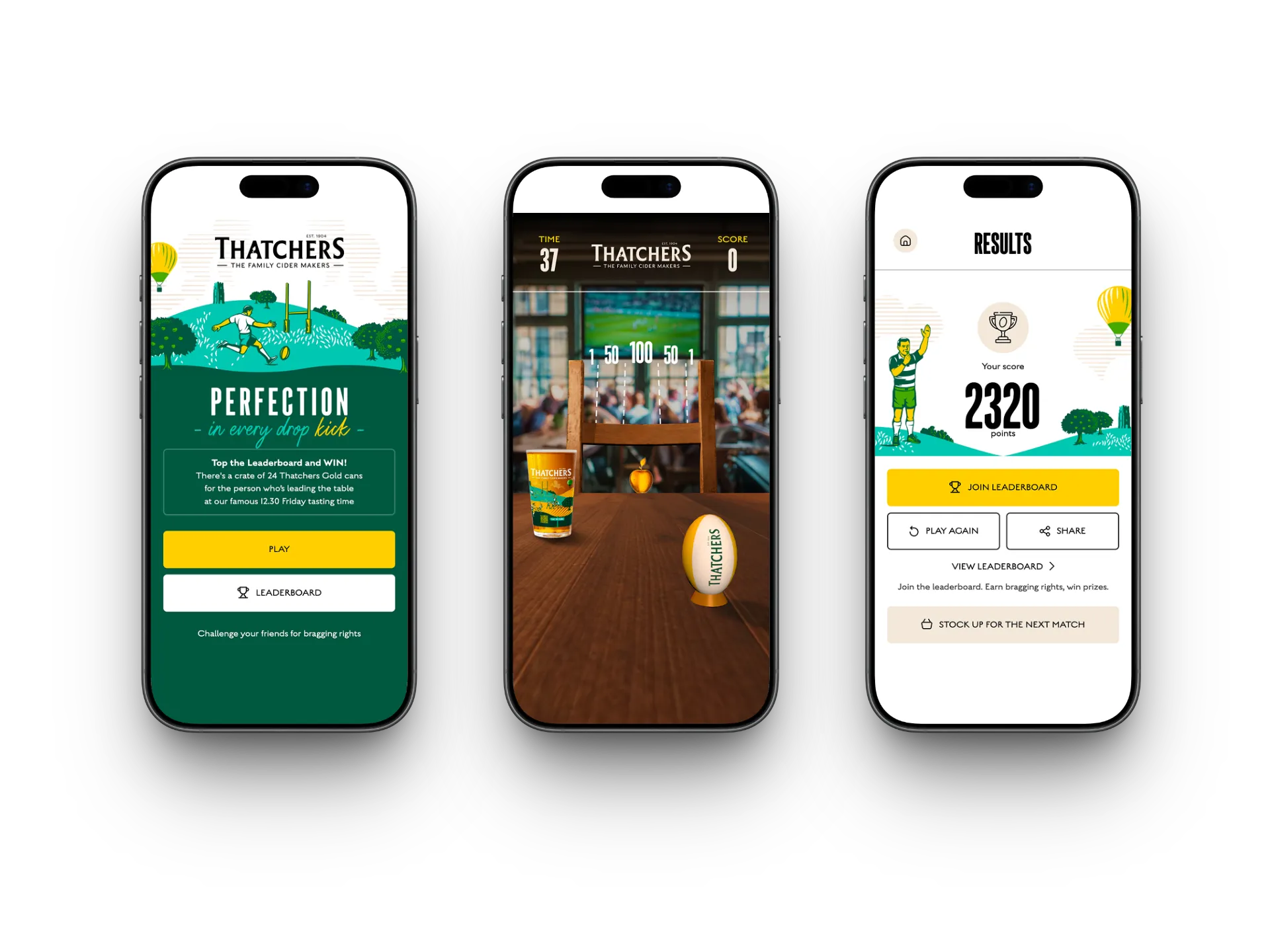
Perfection in Every Dropkick
Thatchers Cider

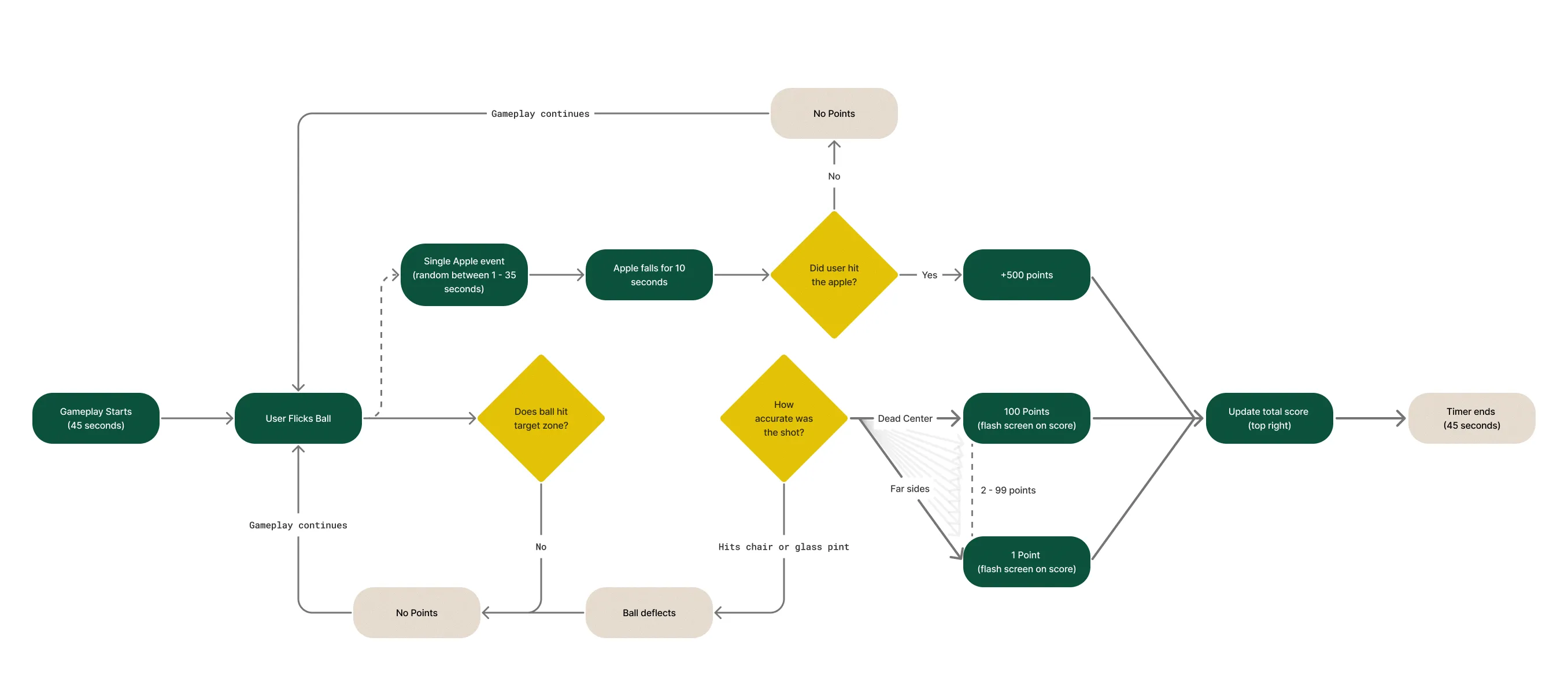
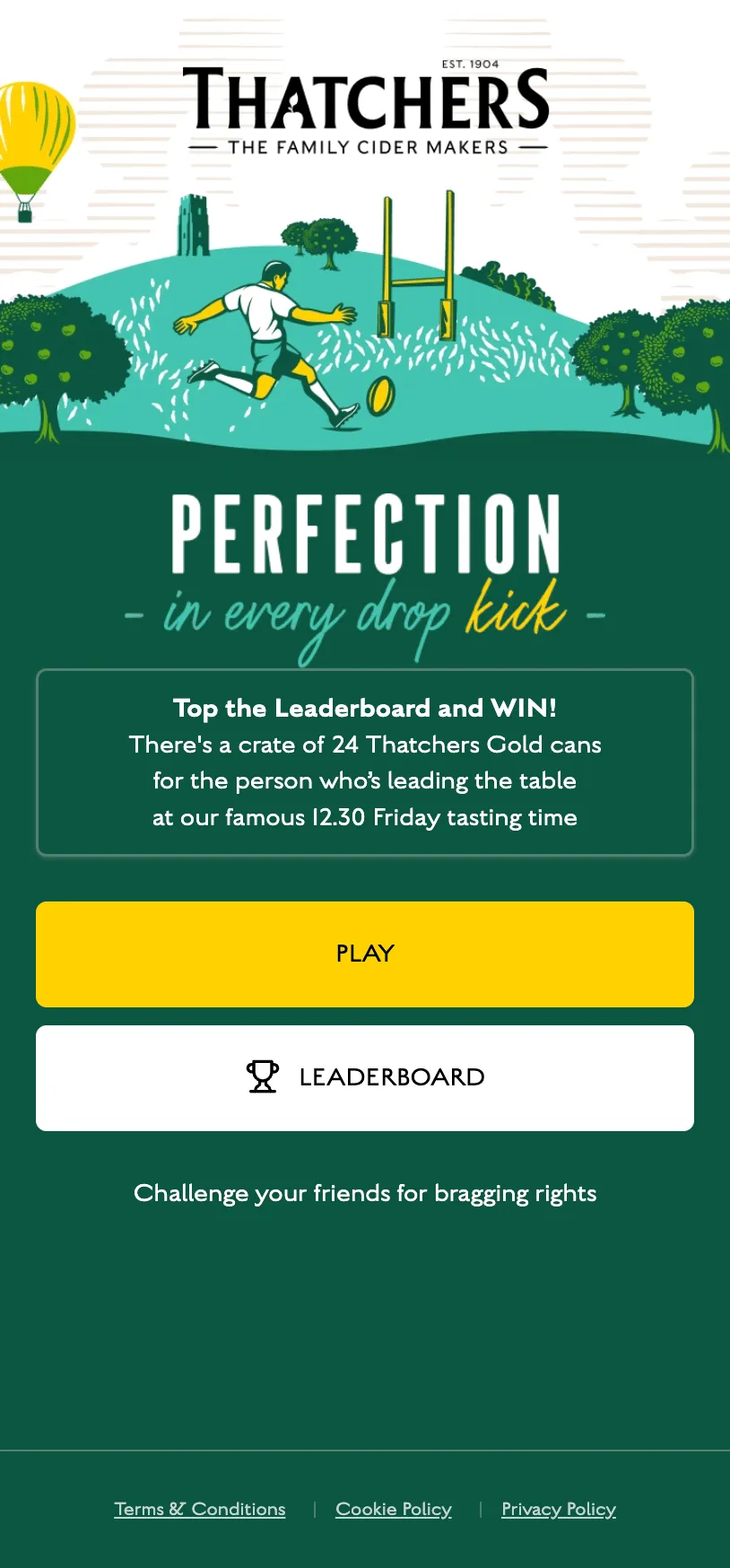
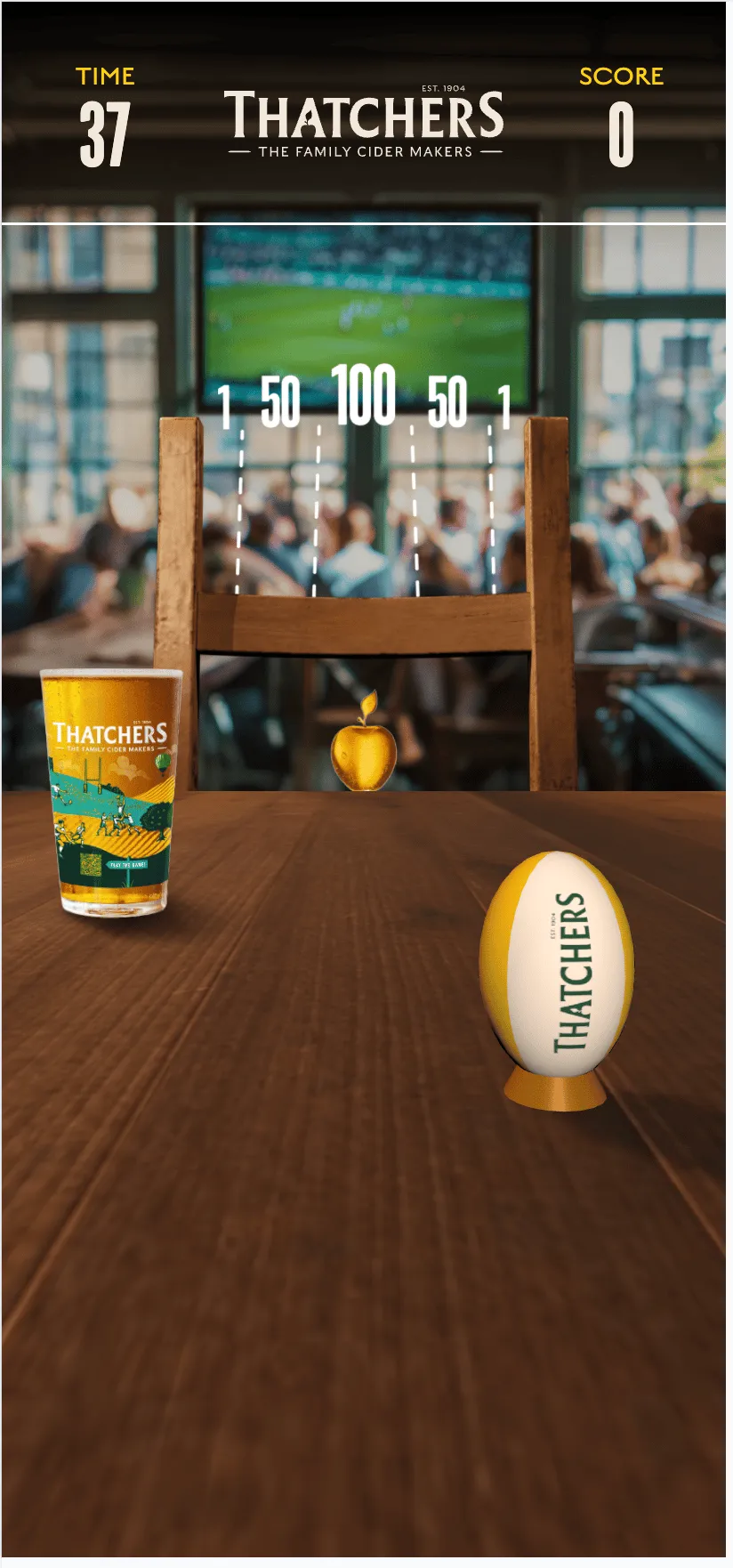
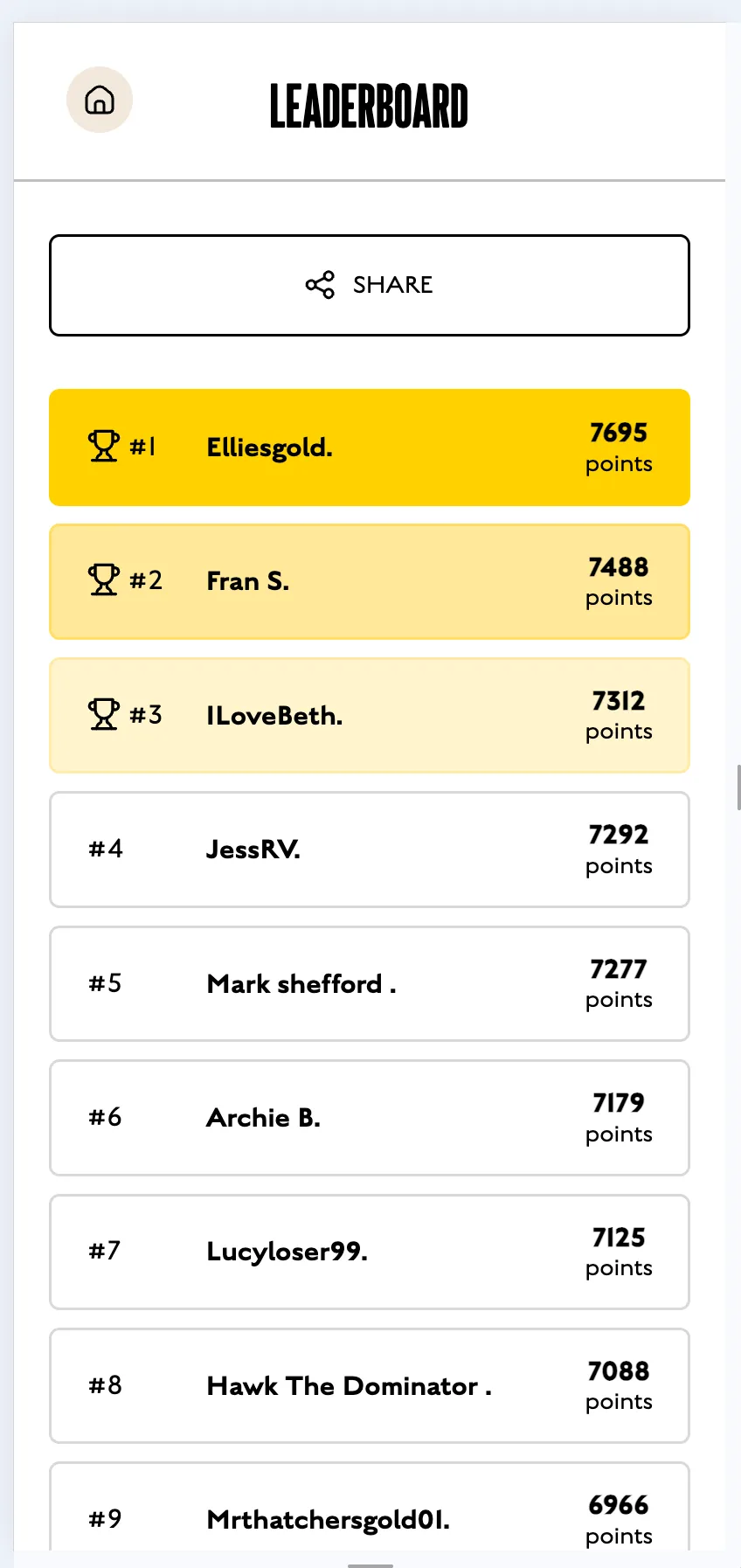
Scan a QR code on a piece of Thatchers’ rugby glassware and you get forty-five seconds to flick a rugby ball across a pub table at goal posts marked out on the back of a chair. Dead centre scores 100, the edges of the target score 1, and hitting the chair or your glass scores nothing. At a random moment a golden apple appears, worth 500. Scores go onto a live leaderboard, and the weekly prize is drawn at 12:30 every Friday, the moment Myrtle Farm stops for Martin Thatcher to taste the cider.
It ran in a mobile browser with no app to install, it was designed and shipped in three weeks, and it was played more than 50,000 times in the first three weeks of the campaign. I was the only UX designer on the project and led the UX end-to-end.
The Challenge
The campaign objective was specific and not really about digital at all: drive footfall into pubs during the Six Nations, and increase dwell time once people were there. That set the constraints more tightly than the brief did.
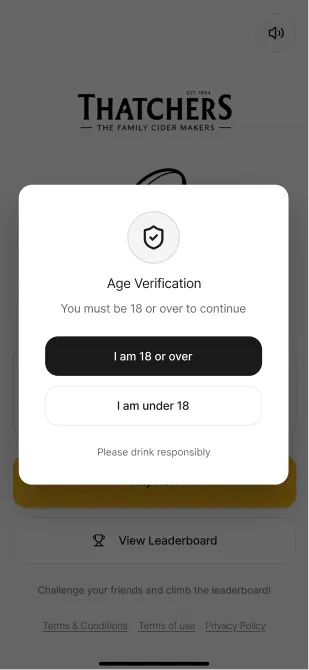
A pub during a live match is loud, crowded and socially competitive, so attention is borrowed rather than given. The device is the player’s own phone, reached by QR code, so no install and no account. Thatchers is an alcohol brand, so an age gate had to sit in front of everything. And the session had to fit between passages of play, which is where forty-five seconds came from.
Defining the Experience
I mapped the end-to-end journey and the moment-to-moment gameplay flow together, as a single artefact, so the game and the UX around it were never designed as separate problems. Mapping it early also forced the unglamorous branches into view while they were still cheap to solve: unsupported devices, failed age checks, lost connection mid-round, form errors.

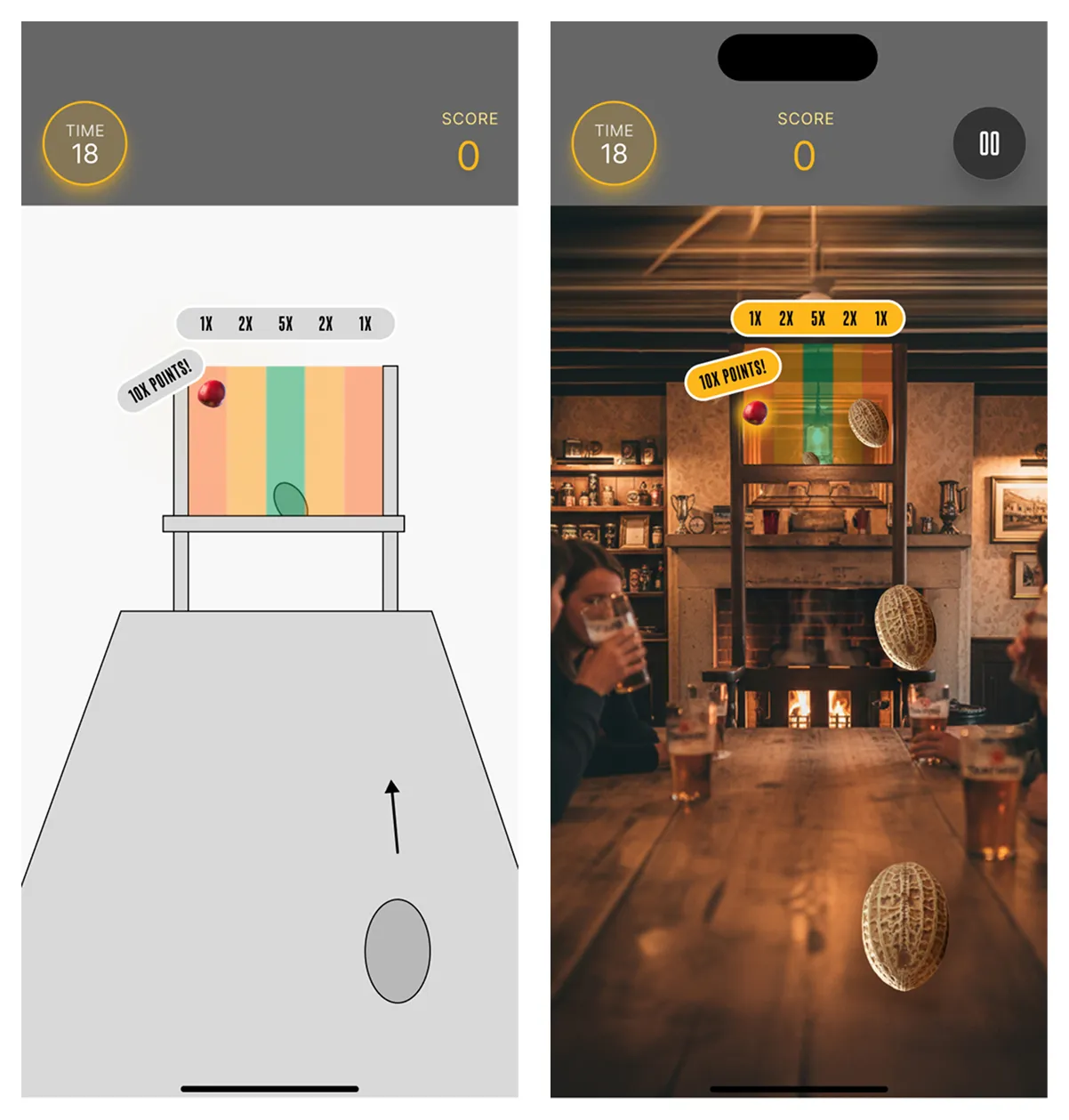
The same pass defined the scoring model. Weighting the target from 1 at the edges to 100 at dead centre meant a near miss still registered as a near miss rather than a failure, which matters when a player has one round to decide whether the game is worth repeating. The golden apple broke the rhythm, giving a reason to stay alert through the middle of a round rather than settling into the same throw.
Wireframing and Prototyping
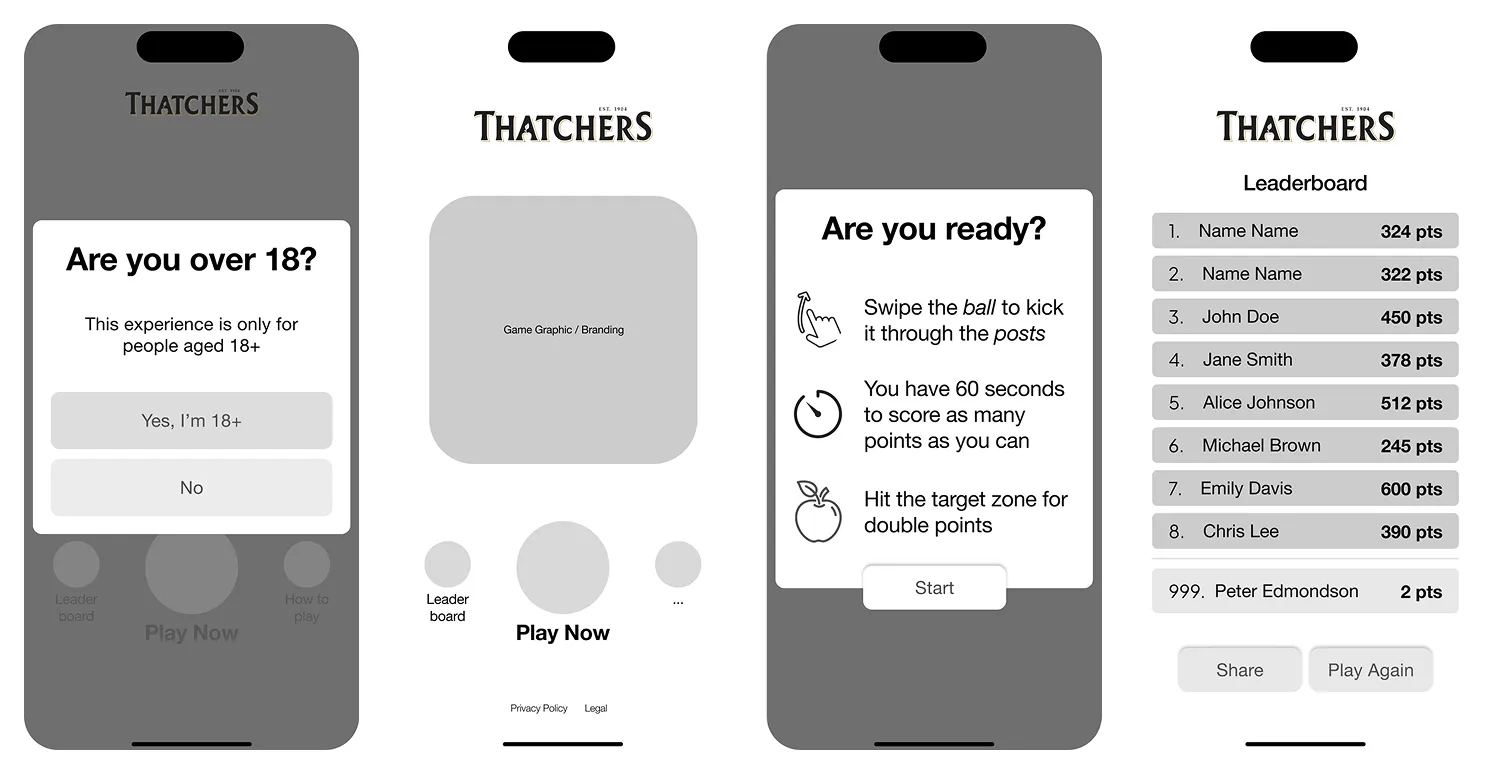
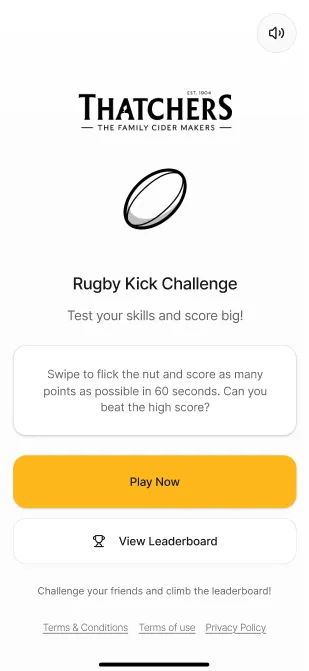
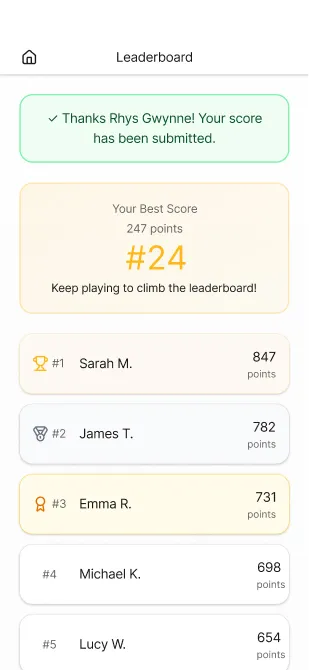
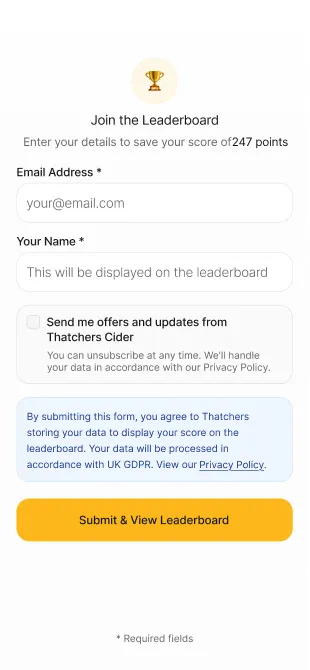
I wireframed the screens surrounding gameplay — age check, start state, instructional overlay, pause, timer, results, leaderboard and prize entry — where structure was the risk and static frames were the faster tool.
Gameplay was a different problem. You cannot review a flick in a static frame. So for the gameplay screens I used AI-assisted prototyping and vibe coding to make something playable rather than something illustrated, which let me iterate on structure and control feel in the same artefact and hand the developer a working reference instead of a description of one. With three weeks on the clock, the point was to find out whether the core interaction worked before build time was spent discovering that it didn’t.
Reducing Friction at Game Start
A swipe-to-throw control is not self-evident. Send a player straight into gameplay and the opening seconds go on working out that the screen wants a flick rather than a tap, which in a pub is long enough for someone to look up and rejoin the conversation instead.
The obvious fix is a dedicated instructions screen. In a forty-five-second game that costs more than it solves: a screen the player has to read and dismiss sits between them and the thing they came for, and the time spent on it is measured against a total experience of forty-five seconds.
I proposed an instructional overlay rendered directly over the game on load, dismissible instantly by anyone who already knows what to do. Instructions are present exactly when needed and cost nothing to skip. The pattern comes from iMessage games, which solve the same problem under the same pressure.
Getting the Flick to Feel Right
The largest risk in the product was not a flow. It was feel.
A swipe-to-throw control has no physical feedback, so whether the game reads as good rests almost entirely on the mapping between how fast a thumb moves and how fast the ball leaves the table. Too sensitive and every throw sails past the posts, which a player experiences as the game being broken rather than themselves being inaccurate. Too damped and it feels sluggish, which reads as cheap.
That is not a judgement you can make from a wireframe, so I ran internal sessions on the interactive prototypes, specifically on control sensitivity, and we tuned the relationship between swipe speed and ball speed until the throw felt natural. I used the same sessions to watch where thumbs landed, whether people swiped from the ball or from anywhere on screen, and whether the control was understood without being explained.
Asking for the Email After the Score, Not Before the Game
The leaderboard is what turns a forty-five-second game into repeat play, and repeat play is what serves dwell time. But joining it meant a form with an email address, a name and a marketing consent, which is a significant ask in a pub.
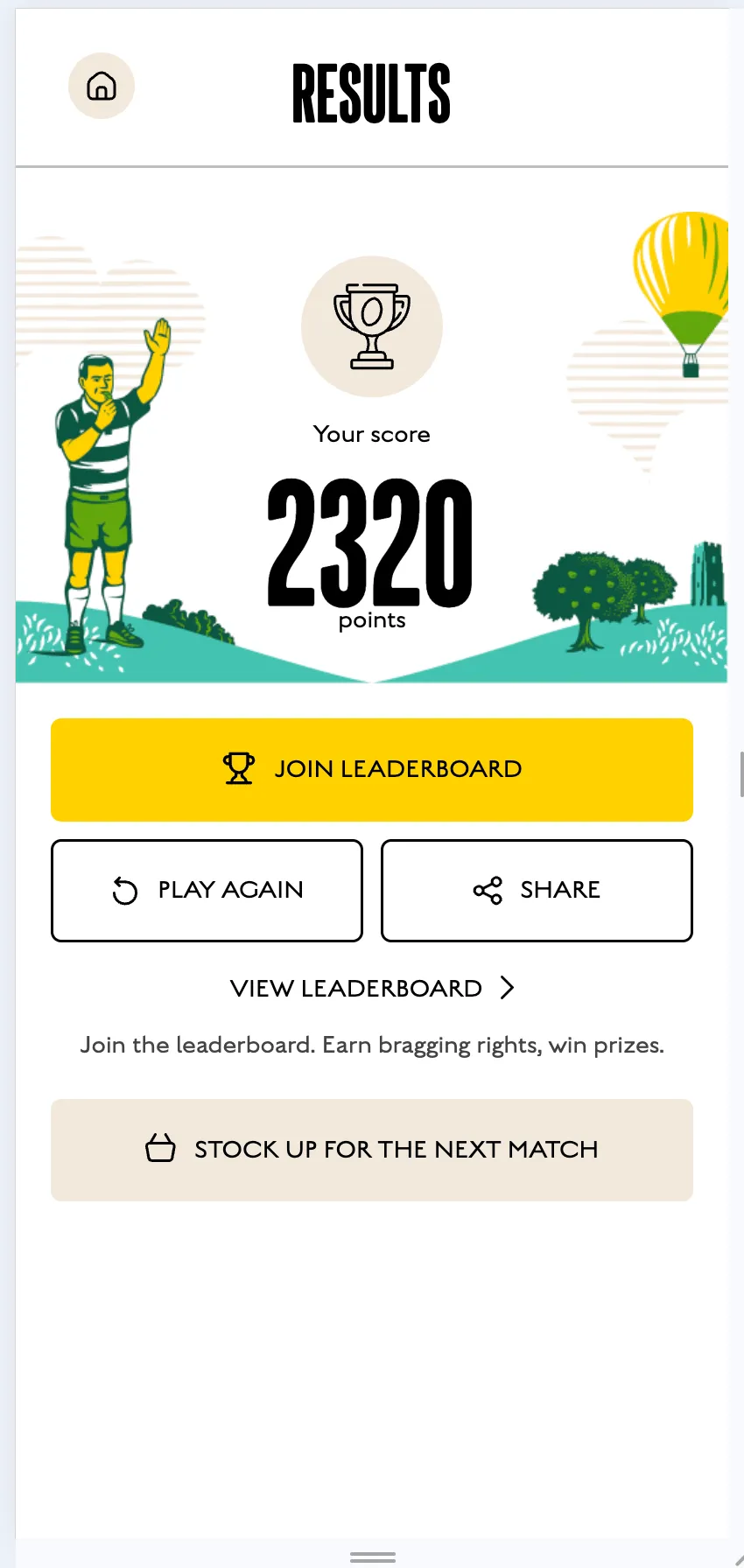
Putting that form before gameplay would have collected addresses from people with nothing invested yet, and lost the ones who scanned the code out of idle curiosity. So play is ungated after the age check, and the ask arrives on the results screen, where the player has a score and a reason to want it recorded. Play Again and Share sit alongside Join Leaderboard, which keeps the form skippable and protects the behaviour the campaign was funded to produce.
Visual Design and Build
Final visual designs were created by the designer, translating the wireframes into a polished, on-brand experience. A 3D game world was built by the developer, with specialist front-end and back-end work supporting animation, scoring, timing and prize entry. Copy was written by a copywriter and integrated into the UX flows.
What I Tested, and What I Didn’t
Testing was internal. I ran sessions with colleagues on interactive prototypes covering control sensitivity and interaction patterns, and that work changed the product: the flick mapping was tuned as a direct result.
It stopped there. Nobody outside the agency played it before launch, nobody observed it in a pub — the environment the whole thing was designed for — and after launch, with 50,000 plays generating behavioural data, none of it was reviewed against the decisions above. Completion rates alone would have shown whether the overlay was being read or dismissed unread. Some of that was the trade a three-week timeline forces; the post-launch review wasn’t, and it’s the first thing I’d build into the World Cup adaptation.
Outcome
The activation generated over 50,000 unique plays in the first three weeks of the campaign.
Thatchers approved an expansion on the strength of the launch, funding features scoped and then cut for budget — local leaderboards and location-based prizes, both of which push harder on the footfall objective by making the competition specific to the pub you are standing in. The experience is now being adapted for the 2026 Football World Cup, reusing the underlying mechanics and UX principles with a sport-specific reskin.
Key Learnings
- Feel has to be prototyped, not drawn. The riskiest part of this product was a physical-seeming interaction with no physical feedback.
- Session length is a design constraint, not a specification. Forty-five seconds decided the onboarding, the scoring model, and how much could be asked of a player at the end of a round.
- Speed shipped it, and speed cost me the loop. Three weeks got the product live, and it also meant the data that could have told me whether these decisions were right went unread.
Recognition
IPM Awards 2026
- Gold — Best Small-Budget Campaign
- Bronze — Alcoholic Beverage
- Bronze — Best Integrated Campaign
Creativepool Annual 2026
- Bronze — Application
- People’s Choice (public vote) — Wave
- Shortlisted — Artificial Intelligence
Recognition for the Bray Leino team. I led the UX.
In the Media
- Leicester Tigers (opens in a new tab) — TikTok
- Rise & Shine (opens in a new tab) — 14 Jan 2026
- CLH News (opens in a new tab) — 5 Feb 2026
- Use Your Local (opens in a new tab)
- MISSION Group awards announcement (opens in a new tab) — 8 Jul 2026